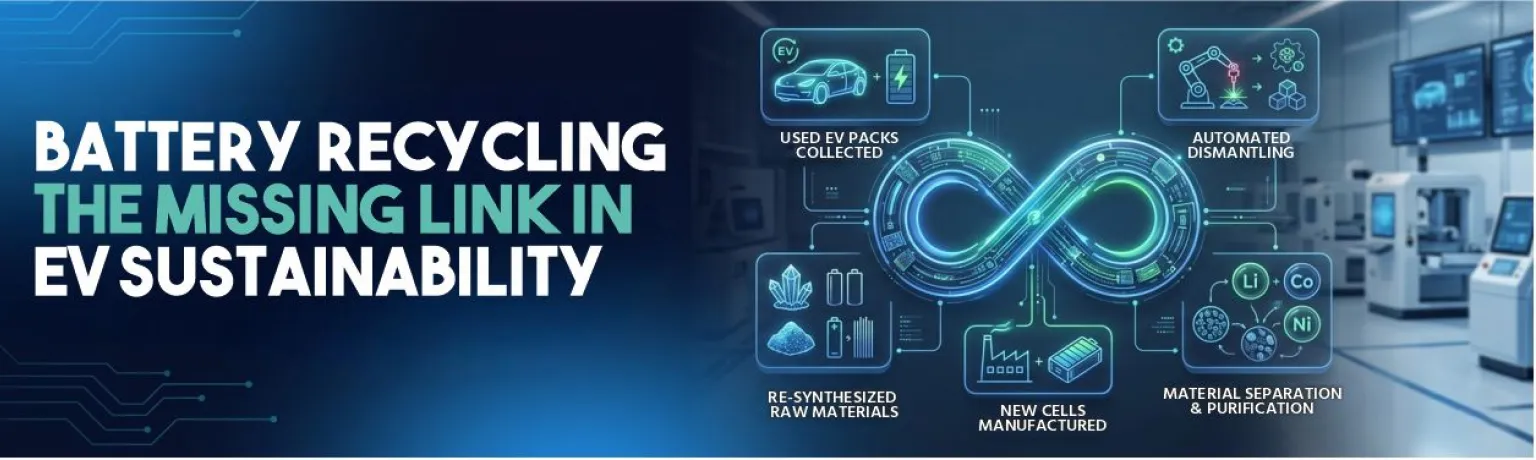
Battery Recycling: The Missing Link in EV Sustainability
In Chile’s Atacama Desert, one of the driest places on Earth, lithium mining for electric-vehicle (EV) batteries consumes up to 500,000 gallons of water per ton of lithium extracted. While EVs promise zero tailpipe emissions and a path to low-carbon mobility, their sustainability hinges on a critical question: what happens to their batteries at the end of their life? Without robust recycling and reuse systems, the EV revolution risks trading one environmental challenge for another.
The Hidden Cost of EV Batteries
At the core of every EV is a lithium-ion battery, powered by critical minerals like lithium, cobalt, nickel, manganese and graphite. Extracting these materials is resource-intensive and often environmentally damaging. For example, cobalt mining in the Democratic Republic of Congo has been linked to habitat destruction and human rights concerns, while lithium extraction in arid regions strains scarce water resources (World Resources Institute, 2023). Although EVs produce no tailpipe emissions, their upstream supply chain carries a significant environmental footprint. A sustainable EV ecosystem must address these impacts to avoid merely shifting the burden from fossil fuels to mining.
The Growing Challenge of Battery Waste
Lithium-ion batteries typically last 8 to 15 years before their capacity falls below the “automotive-ready” threshold. At this stage, they can be repurposed for less demanding applications or recycled. Improper disposal risks toxic chemical leaks, fire hazards and the loss of valuable materials. The International Energy Agency (IEA) projects that by 2050, recycling could supply 25–40% of global demand for lithium, nickel and cobalt, but only if collection and recycling systems scale rapidly (IEA, 2024). Without these systems, millions of tons of battery waste could accumulate over the next two decades, undermining EV sustainability.
Recycling: A Path to Circularity
Battery recycling can transform waste into a valuable resource, reducing the need for new mining and cutting greenhouse-gas emissions. Recycling critical minerals can produce up to 80% fewer emissions compared with virgin material extraction (Recycled Materials Association, 2024). The industry relies on two primary recycling methods:
- Pyrometallurgical recycling: High-temperature smelting recovers metals like nickel and cobalt, but is energy-intensive and less selective.
- Hydrometallurgical recycling: Chemical leaching extracts metals with greater precision and lower emissions, though it requires careful chemical management.
Emerging direct-recycling techniques aim to recover intact cathode materials for reuse, offering higher material efficiency. However, these methods are not yet widely commercialised due to technical and scalability challenges (Nature Reviews Materials, 2024). Scaling recycling also faces hurdles like diverse battery chemistries (e.g., LFP vs. NMC), complex pack designs, and high costs of disassembly, which can make recycling economically less favourable than primary mining.
Second-Life Applications: Extending Battery Value
Retired EV batteries often retain 70–80% of their original capacity, making them ideal for stationary energy storage. For example, Nissan repurposes Leaf batteries to power streetlights in Japan, while Tesla uses second-life batteries for grid storage in California (Earthworks & Institute for Sustainable Futures [ISF], 2021). These applications support renewable-energy integration, stabilise microgrids and delay waste generation. However, challenges like safety testing, standardisation and certification must be addressed to scale second-life solutions effectively.
Building a Circular Battery Economy
A truly sustainable EV ecosystem requires a circular battery economy that prioritises reuse, repurposing and recycling. Key enablers include:
- Design for disassembly: Simplifying battery structures to facilitate recycling and reduce costs.
- Standardisation: Uniform battery formats and chemistries to streamline recycling processes.
- Extended Producer Responsibility (EPR): Policies holding manufacturers accountable for battery collection and recycling, as seen in the EU’s Battery Regulation (European Commission, 2023).
- Local recycling infrastructure: Domestic facilities to minimise transport emissions and reliance on global waste flows.
Globally, progress is uneven. China leads in recycling capacity, processing over 50% of global EV-battery waste, while Europe’s Battery Regulation sets ambitious targets for 70% recycling efficiency by 2030 (IEA, 2024). In India, the Battery Waste Management Rules, 2022 mark key progress by mandating producer responsibility, and startups like Attero Recycling and Lohum are achieving over 90% material recovery (Ministry of Environment, Forest and Climate Change, 2022). Yet India’s recycling infrastructure remains nascent, especially faced with an estimated 128 GWh of used battery volume by 2030 (India) that must be managed (NITI Aayog, 2022).
What Consumers Can Do
Consumers play a critical role in closing the battery loop:
- Choose sustainable brands: Opt for manufacturers with established battery take-back and recycling programmes.
- Use authorised recycling channels: Return spent batteries through certified collection points to prevent informal disposal.
- Support second-life products: Where available, explore opportunities to buy or lease second-life battery systems for home energy storage.
By making informed choices, consumers can drive demand for circularity and hold manufacturers accountable.
The Road Ahead
EVs are a cornerstone of climate action, but their sustainability depends on managing the full battery lifecycle. Mining less, reusing more and recycling smarter can turn the battery challenge into a circular-economy opportunity. From policy-makers enforcing EPR, to manufacturers designing recyclable batteries and consumers supporting responsible brands, every stakeholder has a role to play. The future of mobility must be not just electric, but truly sustainable.
References
Earthworks & Institute for Sustainable Futures. (2021). Reducing new mining for electric vehicle battery metals. Earthworks. https://earthworks.org/wp-content/uploads/2021/09/UTS-EV-battery-metals-sourcing-20210419-FINAL.pdf
European Commission. (2023). Regulation (EU) 2023/1542 concerning batteries and waste batteries. https://eur-lex.europa.eu/eli/reg/2023/1542/oj
International Energy Agency. (2024). Recycling of critical minerals – Executive summary. https://www.iea.org/reports/recycling-of-critical-minerals/executive-summary
Ministry of Environment, Forest and Climate Change, India. (2022). Battery Waste Management Rules, 2022. https://moef.gov.in/wp-content/uploads/2022/08/Battery-Waste-Management-Rules-2022.pdf
Nature Reviews Materials. (2024). Advances in battery recycling technologies. https://www.nature.com/articles/s41578-024-00612-3
Recycled Materials Association. (2024). Environmental benefits of battery recycling. https://www.recycledmaterials.org/reports/battery-recycling-2024
World Resources Institute. (2023). Critical minerals and water impacts. https://www.wri.org/insights/critical-minerals-mining-water-impacts
NITI Aayog & Green Growth Equity Fund Technical Cooperation Facility. (2022). Advanced chemistry cell battery reuse and recycling market in India. https://www.niti.gov.in/sites/default/files/2022-07/ACC-battery-reuse-a…