Long before “sustainability” became a global buzzword, Indian households lived it in their own way. You might remember how your grandmother would patch up worn clothes, reuse glass jars for storage, or hand down tools and utensils from one generation to the next. Nobody called it a circular economy back then. But these everyday habits reflect the same principles behind the modern circular economy: making things last, reusing, and minimizing waste.
The linear “take-make-dispose” model dominates today’s industrial economy, yet it comes at a heavy environmental and social cost. Overextraction of resources, mounting waste, and carbon-intensive production have stressed ecosystems worldwide. The circular economy offers an alternative, a system that aims to keep resources in use as long as possible, recover their value, and regenerate materials at the end of life, while still supporting economic growth.
What the Circular Economy Really Means
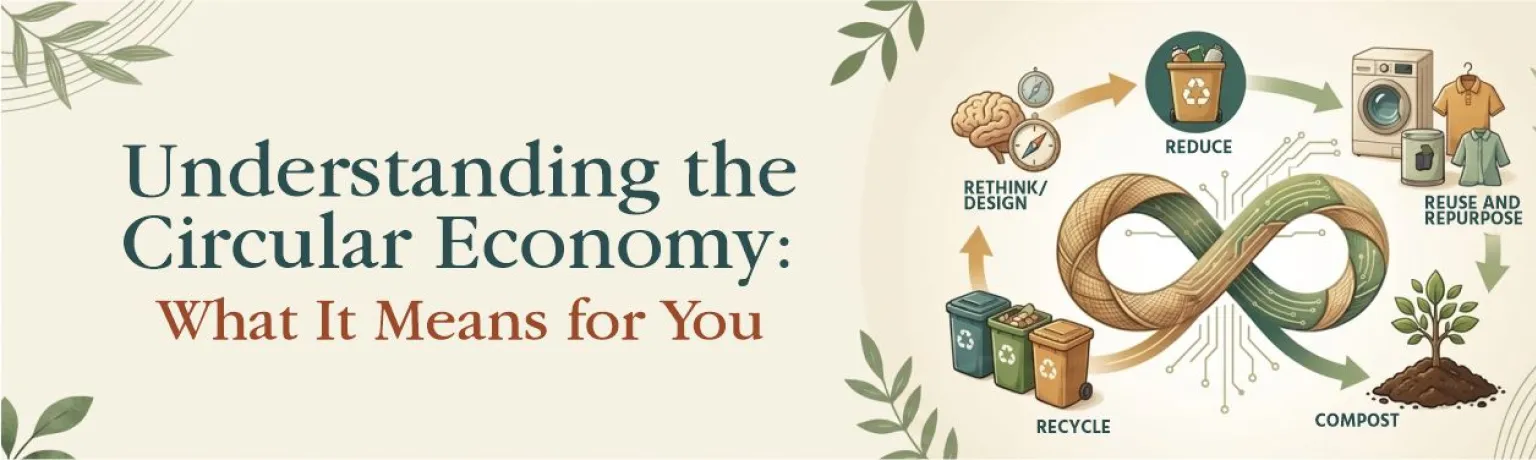
At its core, a circular economy is about rethinking how we produce and consume. Instead of discarding items after use, we extend their life through repair, reuse, remanufacturing, and recycling. Modern frameworks often summarize this as the “3Rs + 1”:
- Reduce: Use fewer resources from the start.
- Reuse: Extend product lifespans through repairs or second-hand use.
- Recycle: Recover materials to make new products.
- Redesign: Create products that are durable, repairable, and easier to recycle.
Interestingly, these principles are not new. They resonate with everyday practices that Indian households have followed for generations. Circularity is essentially a modern name for a mindset many of us grew up with.
Why Circularity Matters Today
Global material extraction has more than tripled since 1970, while waste generation continues to rise sharply. By 2050, without systemic change, annual resource extraction could reach 190 billion tons, contributing to biodiversity loss, climate change, and social inequity (Circle Economy, 2022).
Adopting circular practices can:
- Reduce greenhouse gas emissions by up to 40% in industrial sectors.
- Build resilient supply chains by reducing dependence on virgin raw materials.
- Generate economic opportunities, including jobs in repair, remanufacturing, and recycling.
For individuals, it means rethinking everyday consumption habits, choosing durability over convenience and valuing quality over quantity. Even small lifestyle choices can add up when millions of people adopt them.
Global and Indian Context
Several countries are already taking circularity seriously:
- European Union: The EU Circular Economy Action Plan promotes eco-design, sustainable materials, and recycling targets for electronics, packaging, and batteries (European Commission, 2020).
- China: Its Circular Economy Promotion Law encourages industrial parks and manufacturers to reduce waste and recover materials efficiently.
- Japan: Efficient resource loops in automotive and electronics industries, including remanufacturing and component reuse, show that circularity can scale effectively.
In India, rapid urbanization and population growth generate unprecedented amounts of waste. The country produces over 150 million tons of municipal solid waste annually, yet less than 30% is formally processed (Ministry of Environment, Forest and Climate Change, 2021). Policies like the Plastic Waste Management Rules and Battery Waste Management Rules (2022) signal growing governmental support. Innovative startups are also emerging in e-waste recycling, upcycling textiles, and refurbishing used batteries for second-life applications, creating scalable models for circular business practices.
How Individuals Can Participate
Circularity is not just for governments and companies. It starts at home. In many ways, it is a return to the mindset our elders had:
- Buy smart, use wisely: Choose products that are durable, repairable, or modular.
- Reuse and repurpose: Before discarding items, ask if they can be reused, like an old jar, a box, or even clothing.
- Recycle responsibly: When products reach the end of their life, use certified recycling channels for e-waste, plastics, and batteries.
- Support circular businesses: Choose brands that offer take-back schemes, repair services, or sustainable packaging.
These habits, rooted in both tradition and modern practice, collectively reduce waste and conserve resources.
Building a Circular Future
A circular economy is both a challenge and an opportunity. It requires collaboration across governments, industries, and individuals. Policymakers must provide incentives, regulations, and infrastructure for resource recovery. Businesses must redesign products and supply chains for longevity and recyclability. Consumers must embrace mindful consumption and support sustainable practices.
The circular economy is more than a waste management strategy. It is a way to rethink growth, maximize value, and protect the planet for future generations.
References (APA 7th Edition)
Circle Economy. (2022). The circularity gap report 2022. https://www.circularity-gap.world/2022
European Commission. (2020). Circular economy action plan: For a cleaner and more competitive Europe. https://ec.europa.eu/environment/strategy/circular-economy-action-plan_…
Ministry of Environment, Forest and Climate Change, India. (2021). Annual report 2020–21: Waste management and sustainable development. https://moef.gov.in/